

Chinese Science Class for Kids: How Immersive STEM Builds Fluency
- Future Chinese
- Jul 7
- 11 min read

Updated: Jul 15
What if your child’s most anticipated hour of the week wasn't a video game or a playdate, but their Mandarin lesson? It sounds like a dream for many parents who currently face daily battles over language practice. You probably recognize the pattern: the slumped shoulders when the textbooks come out, or the way they'll answer you in English even when you speak to them in Mandarin. By introducing a chinese science class for kids, you can break this cycle of boredom. It's difficult to watch a language you love feel like a burden, especially when traditional classes often focus on repetitive drills that lack real-world excitement.
There's a more vibrant way to learn. We'll show you how interest-based STEM activities allow children to acquire complex vocabulary naturally while they're busy testing hypotheses or building models with the Maker & Coder ecosystem. This article explores how an immersive environment transforms language from a chore into a tool for discovery. You'll discover how this approach builds genuine fluency and gives your child the confidence to express sophisticated ideas with ease. It's time to move beyond the classroom and into the laboratory of imagination.
Table of Contents
What is a Chinese Science Class for Kids?
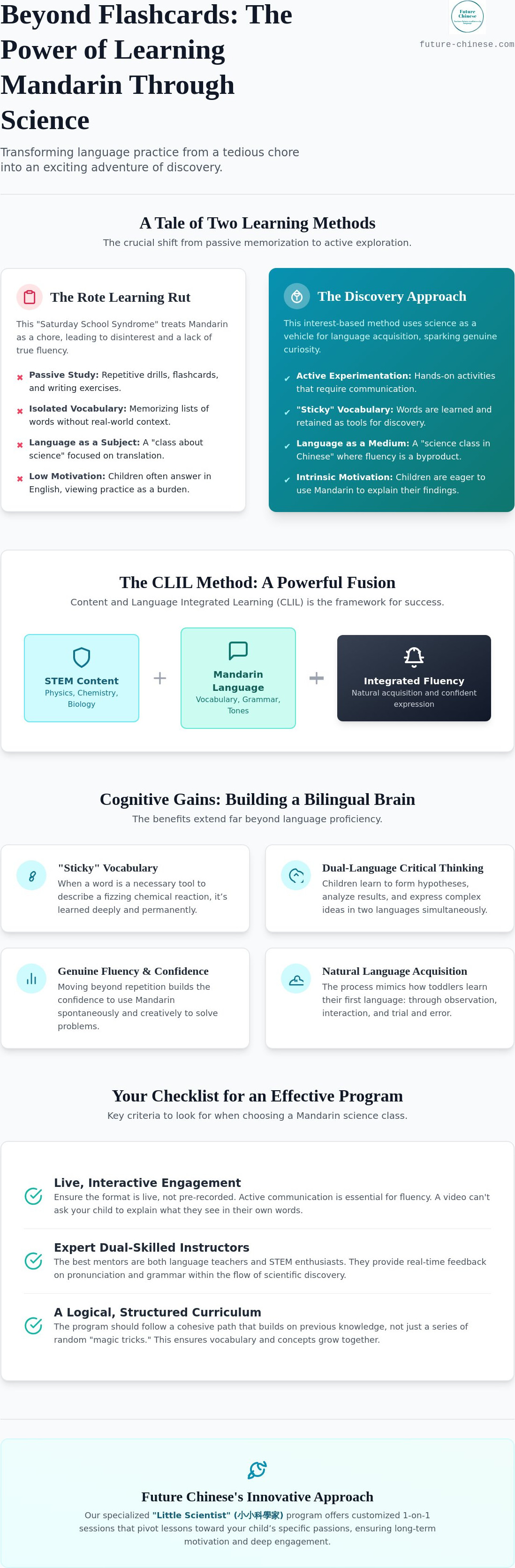
Imagine a classroom where the goal isn't just to repeat the word for "gravity," but to feel it in action. That's the core of a chinese science class for kids. It's built on a framework called Content and Language Integrated Learning (CLIL). In this model, Mandarin isn't just a subject; it's the medium for discovery. Instead of studying the language in a vacuum, children use it to unlock the secrets of the physical world.
By 2026, we're seeing a major shift among families living abroad. Parents are moving away from traditional drills in favor of interest-based language immersion. There's a vital difference between a "language class about science" and a "science class in Chinese." The former focuses on translating terms. The latter prioritizes the experiment. The language is acquired as a byproduct of genuine curiosity. This format mimics natural first-language acquisition. Children learn through observation, trial, and error, just as they did when they were toddlers.
The Core Components of an Effective STEM-Mandarin Program
Success in this format relies on active experimentation rather than passive listening. When a child mixes vinegar and baking soda, the words for "reaction" or "bubble" aren't just entries in a textbook. They're necessary tools to describe the fizzing mess on the table. We use scaffolded vocabulary that grows alongside your child's curiosity. A native-speaking mentor plays a crucial role here. They don't just lecture; they guide the scientific discovery. By asking open-ended questions, they encourage children to use Mandarin to explain their findings and test their theories.
Why Traditional Rote Learning is Failing Bilingual Kids
Many families struggle with what we call "Saturday School Syndrome." This happens when children view Mandarin as a chore filled with repetitive writing and flashcards. Memorizing lists of animals or colors rarely leads to true fluency. It's because there's no functional "why" for using the language. Science provides that purpose. It gives the child a reason to communicate. A student might forget a word on a worksheet, but they'll remember it after using it to solve a puzzle in a chinese science class for kids. This hands-on approach creates a lasting connection between the language and the real world.
Key Criteria for Choosing the Right Mandarin Science Program
Selecting the right educational environment for your child is a deeply personal decision. For families in Europe seeking a comprehensive bilingual foundation, you can discover Meridian Private Primary School as an example of how immersive environments foster early academic success. It goes far beyond simply finding a convenient time slot on a calendar. When you're looking for a chinese science class for kids, you're looking for a space where curiosity is protected and language is practiced without fear. Many parents mistakenly prioritize flashy graphics or pre-recorded videos, but these passive formats can't replace the spark of a live conversation. A video won't notice when your child’s eyes light up at a chemical reaction; it won't ask them to explain what they see in their own words.
A logical scientific progression is equally vital. The curriculum shouldn't feel like a collection of random "magic tricks." Instead, it should follow a cohesive path that builds on previous knowledge, aligning with global standards like America's Strategy for STEM Education. This strategic approach ensures that as the science becomes more complex, your child’s Mandarin vocabulary expands to meet the challenge. This creates a natural bridge between their academic growth and their heritage language.
Instructor Expertise: Language Teacher or Scientist?
The most effective mentors are those who inhabit both worlds. They're creative guides who understand the nuances of Mandarin pedagogy while possessing a genuine passion for STEM. Real-time feedback is the "secret sauce" of fluency. When a child is excited about a volcano experiment, they might forget their tones. A skilled instructor catches these slips immediately, correcting them within the flow of the conversation. This builds a sense of emotional safety. If you want to see how this personalized attention can ignite your child’s interest, our 1-on-1 customized lessons offer the perfect balance of scientific rigor and linguistic support.
Platform Accessibility and Interactive Tools
Since many families live across different time zones, the learning platform must be both flexible and robust. High-quality video is a baseline requirement; you need to see the instructor's facial expressions and the details of the experiment clearly. Interactive digital whiteboards allow children to "draw" their hypotheses or label diagrams in Mandarin, making the virtual experience feel tactile. The goal is to facilitate hands-on work even through a screen. When a platform is intuitive, the technology fades into the background, leaving only the joy of discovery and the sounds of a child confidently speaking a second language.
The Cognitive Benefits of Learning Mandarin Through Science
When a child is fully immersed in a chinese science class for kids, their brain undergoes a unique shift. Instead of treating Mandarin as a series of isolated rules to be memorized, the brain begins to process it as a functional tool. This is known as task-based learning. When a student uses Mandarin to achieve a specific goal, like balancing a scale or observing a chemical reaction, the language becomes "sticky." The physical action anchors the new vocabulary in the long-term memory, making it much harder to forget than words read from a list.
This approach also cultivates high-level critical thinking skills. Children aren't just learning how to say "water"; they're learning how to hypothesize about its states in two different languages simultaneously. This cognitive flexibility is a hallmark of successful immersion. According to research on dual-language immersion and academic achievement, students in these programs often outperform their peers in core subjects because they've learned to approach problems from multiple linguistic perspectives. It prepares them for a future where adaptability is just as important as knowledge.
One of the most profound benefits is the reduction of language anxiety. Many bilingual children feel pressured to use perfect grammar, which often leads to silence. In a science-focused environment, the focus shifts from the speaker to the experiment. If a child is excited to see a seed sprout, they'll prioritize communication over perfection. This "flow state" allows them to speak more freely, building the confidence they need to tackle complex topics without fear of making mistakes.
Vocabulary Acquisition in Context
Traditional lessons often get stuck on simple nouns like "apple" or "dog." A science-based curriculum pushes past these basics into complex verbs and processes. Students learn to observe, dissolve, and react. These abstract terms become concrete through visual evidence. Every time they repeat a step in the scientific method, they're engaging in a natural language drill. This repetition doesn't feel like work because it's driven by the desire to see the final result of the experiment.
Boosting Confidence and Global Perspective
By discussing "adult" topics like climate change or physics, children develop a sense of authority. They start to see themselves as "Bilingual Scientists," a powerful identity that fosters immense pride. This connection to global innovation shows them that Mandarin isn't just a "home language" for talking to grandparents. It's a key that unlocks future careers in technology and research. They realize that their ability to navigate these topics in two languages gives them a unique advantage in a connected world.
How to Support Your Child’s Science Learning at Home
Learning is a journey that continues long after the lesson ends. You can easily extend the impact of a chinese science class for kids by transforming a small corner of your home into a discovery zone. This dedicated space signals to your child that their curiosity is valued. You don't need a professional lab; simple items like recycled bottles, vinegar, and baking soda are enough to spark a dozen experiments. By placing these materials within reach, you're encouraging them to investigate the world using the Mandarin vocabulary they've recently acquired.
Incorporate scientific inquiry into your daily routines. When you're washing vegetables, talk about which ones float and which ones sink. If you're baking, discuss how heat changes the texture of the dough. These moments provide a functional "why" for using Mandarin. It bridges the gap between a formal lesson and real-life application, ensuring the language remains a living, breathing part of their world. This balance of physical, hands-on tasks effectively offsets screen time, making their digital learning feel more grounded and relevant.
Simple Home Experiments to Kickstart Interest
The "Floating Egg" experiment is a fantastic way to introduce the concept of density. All you need is a glass of water, salt, and an egg. As your child adds salt, use Mandarin terms like "dissolve" and "density" to describe what's happening. Another rewarding project is a week-long plant growth observation. Have your child track the progress of a bean sprout in a jar, labeling the parts of the plant in Mandarin. In these activities, the process matters far more than the result. The goal is to keep the conversation flowing and the curiosity alive.
Resources for Non-Fluent Parents
You don't need to be a scientist or a fluent speaker to support your child’s progress. Many parents find success by using translation apps to look up specific scientific terms alongside their children. This actually models a healthy learning behavior. You're showing them that curiosity is a lifelong pursuit and that it's okay to search for answers together. Finding a community of other bilingual STEM families can also provide fresh ideas and emotional support. If you're ready to see how a structured environment can amplify these home activities, explore our 小小科學家 (Little Scientist) program to give your child a head start.
Little Scientist: Future Chinese’s Innovative Approach
Every child possesses a natural spark of curiosity that traditional textbooks often struggle to ignite. At Future Chinese, we've moved beyond the limitations of passive resources by creating a specialized chinese science class for kids known as "Little Scientist" (小小科學家). This program isn't just about teaching facts; it's about empowering children to navigate the world using Mandarin as their primary tool for discovery. We understand that heritage learners need more than just vocabulary lists. They need a reason to speak, a problem to solve, and a mentor who respects their unique learning pace.
Our approach centers on 1-on-1 customized lessons that adapt entirely to your child’s specific interests. If your child is fascinated by the stars, our curriculum pivots toward astronomy. If they prefer the tiny world of insects, we dive into biology. By aligning the language with their existing passions, we remove the friction often associated with heritage language study. This personalized focus ensures that every minute spent in class is relevant, engaging, and deeply rewarding for the student.
What Happens in a Little Scientist Class?
A typical 1-on-1 session is a structured journey from curiosity to conclusion. We begin with a hypothesis, encouraging the student to predict what might happen in Mandarin. As the experiment unfolds, the teacher acts as a creative guide, prompting the child to describe their observations in full sentences. This isn't a lecture; it's a dialogue. We handle different proficiency levels by providing linguistic scaffolding. A beginner might start with simple descriptive terms, while an advanced student might debate the ethical implications of a scientific discovery. This ensures that the challenge always matches the child’s ability, keeping them in the "flow state" necessary for rapid acquisition.
Join the Future of Mandarin Learning
The Future Chinese philosophy is built on a foundation of warmth, innovation, and empowerment. We've seen incredible transformations where children who once dreaded their weekend language lessons now eagerly prepare their lab kits. These success stories are the heart of what we do. When a child stops seeing Mandarin as a "home chore" and starts seeing it as the language of global innovation, their confidence soars. They become part of a new generation of bilingual thinkers ready to tackle the challenges of tomorrow. If you're ready to transform your child’s relationship with the language, book a trial Little Scientist lesson today and watch their passion for discovery grow.
Empowering Your Child’s Bilingual Journey Through Discovery
Transitioning from the daily struggle of language practice to the genuine joy of scientific exploration is a profound shift for any family. We've seen how a chinese science class for kids turns abstract characters into functional tools for testing hypotheses and describing the natural world. By prioritizing real-world application and task-based learning, your child builds the cognitive flexibility needed to navigate sophisticated topics with confidence. It's about moving beyond the stagnant textbook and into a vibrant space where Mandarin feels like a natural part of their creative identity.
Our expert instructors are dedicated to guiding heritage learners through this journey with empathy and professional precision. Through our specialized "Little Scientist" curriculum, your child receives 1-on-1 personalized guidance that adapts to their unique curiosity and pace. Don't let Mandarin remain a weekend chore when it could be an invitation to explore the universe. Spark your child’s curiosity with a Little Scientist trial lesson today. We're excited to support your family as your child discovers the scientist within, speaking Mandarin with every new discovery.
Frequently Asked Questions
Is my child’s Chinese level high enough for a science class?
Your child's current proficiency level is the perfect starting point for our customized sessions. We adjust the complexity of the Mandarin used based on their comfort, ensuring they can participate in the chinese science class for kids without feeling overwhelmed. Our instructors provide the necessary scaffolding to bridge any gaps between their language skills and the scientific concepts being explored.
What age group is the Little Scientist program designed for?
Our Little Scientist program is primarily designed for children aged 5 to 12. This age range is ideal for hands-on discovery and rapid language acquisition. We tailor the scientific complexity to match your child's cognitive development, ensuring the experiments are both safe and intellectually stimulating for their specific age group.
Do I need to buy expensive equipment for the science experiments?
You don't need to purchase expensive laboratory equipment for our classes. Most experiments utilize common household items like vinegar, baking soda, or recycled bottles. We provide a list of materials before each session so you can easily prepare with what you already have in your kitchen or craft cupboard.
How long is each Little Scientist session?
Each Little Scientist session typically lasts 50 minutes. This duration provides ample time for the initial hypothesis, the hands-on experiment, and the concluding discussion in Mandarin. It's a balanced rhythm that keeps children engaged without causing screen fatigue, allowing for deep focus on both the science and the language.
Can this class help my child prepare for Chinese heritage language exams?
While the focus is on STEM, this class significantly strengthens the skills needed for heritage language exams. By discussing complex topics, your child develops a sophisticated vocabulary and better sentence structure. This practical application builds the confidence and linguistic depth that standard test preparation often lacks, giving them a distinct advantage in formal assessments.
What if my child is a complete beginner in Mandarin?
Complete beginners are welcome to join our specialized beginner Mandarin speaking track. For these students, we use highly visual experiments to introduce basic vocabulary and sentence patterns. Seeing the science happen in real-time provides immediate context for new words, making the learning process much more intuitive than traditional methods.
How do you ensure safety during online science experiments?
Safety is our top priority during every online session. We specifically select experiments that use non-toxic, household materials. Our instructors provide step-by-step guidance and require a parent to be nearby for younger children to ensure all activities are performed correctly and safely within your home environment.
Is the curriculum available in both Simplified and Traditional Chinese?
Yes, our curriculum and materials are available in both Simplified and Traditional Chinese. We respect each family's preference and cultural background. You can choose the character system that best aligns with your child's existing studies or your family's heritage, ensuring a seamless learning experience in our chinese science class for kids.


Comments