

Chinese for Heritage Learners: Bridging the Gap Between Speaking and Literacy in 2026
- Future Chinese
- Jul 7
- 12 min read

Updated: Jul 15
Why are you sitting in a beginner classroom learning how to say "Ni Hao" when you have been speaking Mandarin with your family for your entire life? It is a frustrating reality for many seeking Chinese for heritage learners. You often find yourself stuck in a "jagged profile" where your oral skills are advanced, but your ability to read or write feels years behind. This disconnect doesn't just cause boredom; it creates a genuine fear of losing your cultural identity as the world moves toward more rigorous standards like the HSK 3.0 rollout in 2026.
We understand that your path to fluency is unique. You don't need to start from scratch or suffer through lessons that ignore your existing knowledge. Instead, you can leverage your oral DNA to master literacy and deep cultural connection without the repetitive drills of a standard novice course. This article will show you exactly how to bridge the gap between what you can say and what you can write. We will explore personalized strategies to align your literacy with your speaking level, helping you connect with your roots and unlock professional growth for the years ahead.
Table of Contents
What is a Heritage Learner? Defining the "Jagged Profile"
Language learning is rarely a straight line from zero to hero. For you, it's likely a bit more complex. You grew up hearing the sounds of Mandarin at the dinner table or during holiday visits. You understand the rhythm, the tones, and the cultural nuances, yet looking at a newspaper feels like staring at an unsolvable puzzle. This is the core experience of being a heritage learner. What is a heritage language learner? In simple terms, it's someone who has been exposed to a language at home but lacks the formal education to read or write it proficiently. You have the foundation, but the house isn't fully built yet.
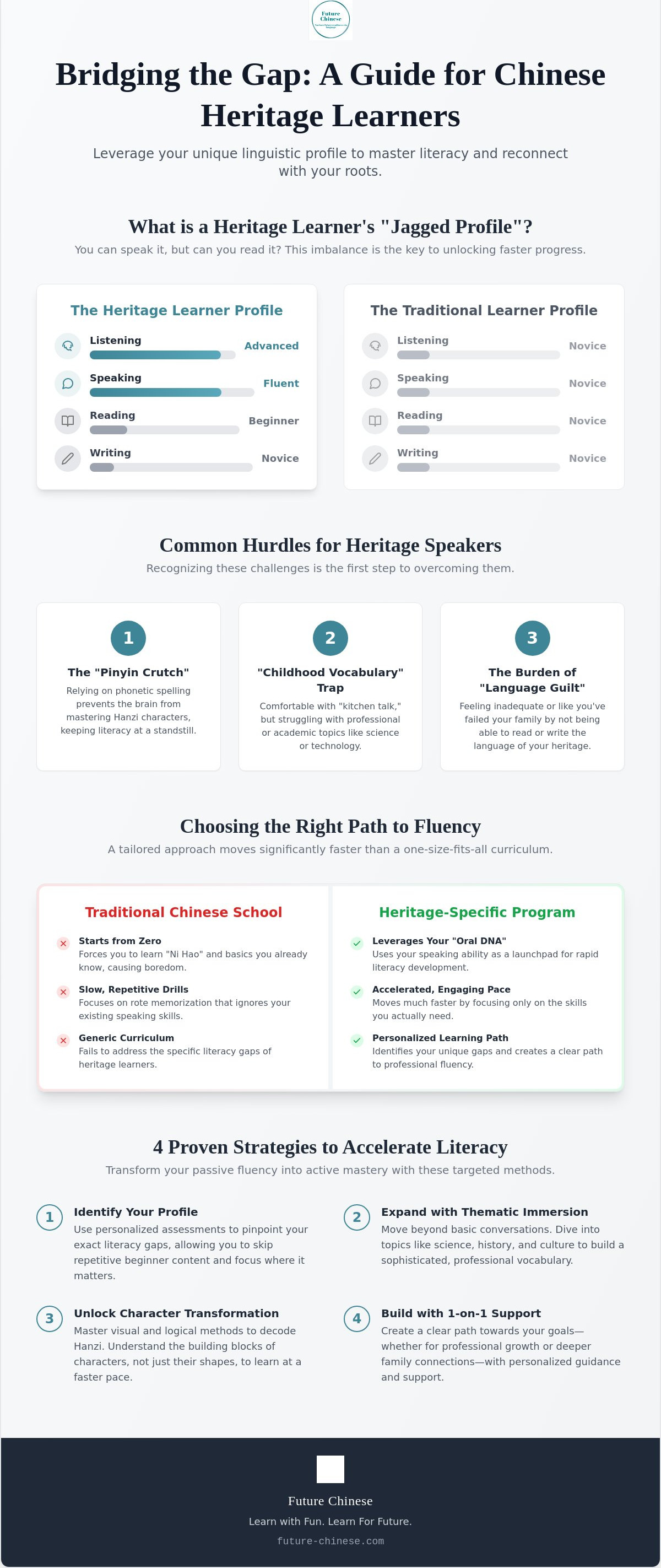
We describe this unique situation as the "Jagged Profile." Imagine a graph where your listening and speaking skills are peaking, while your character recognition and formal grammar knowledge sit near the baseline. Most traditional schools ignore this. They place you in classes with students who have never heard a word of Chinese. You end up bored by "Ni Hao" lessons while simultaneously struggling to write the very words you use every day. High-quality programs for chinese for heritage learners must acknowledge this imbalance. Without a tailored approach, the disconnect between what you can say and what you can write only grows wider.
It's also vital to recognize that the heritage umbrella is incredibly broad. Your family might speak Cantonese, Shanghainese, or Hokkien at home rather than standard Mandarin. Even if your home language is a different dialect, you still possess a cultural intuition and a phonetic awareness that a non-heritage student lacks. This existing language DNA makes your learning path much faster if the curriculum respects your starting point instead of forcing you to start from scratch.
Linguistic vs. Ethnic Identity
You might feel like an impostor because you can't hold a deep political debate or read a classic novel. Your identity isn't defined by a proficiency test. The home language you heard as a child shaped your brain's development, creating neural pathways that make re-learning much more intuitive. A heritage learner is a student with "passive fluency" waiting to be activated. You aren't learning something new; you're finally putting the pieces of your own story together.
The Emotional Burden of the Heritage Speaker
Many students carry "language guilt." You might feel like you've failed your family or that you aren't "Chinese enough" because you can't read a text message from a grandparent. Traditional rote memorization only makes this feeling worse. It turns a cultural connection into a repetitive chore. We believe in shifting the perspective from remediation to empowerment. Instead of fixing what's "broken," we focus on unlocking the vibrant world you already partially inhabit. Learning becomes an act of reclaiming your roots with confidence and joy.
The 3 Main Challenges for Heritage Mandarin Speakers
Having a head start in speaking is a wonderful gift, but it often comes with a set of invisible hurdles that non-heritage students don't encounter. You might feel perfectly confident ordering at a favorite restaurant or chatting with relatives, but the moment a menu lacks pictures or a group chat turns to complex topics, that confidence can vanish. This gap between oral ability and literacy is one of the most common hurdles in chinese for heritage learners. It isn't just about learning new words. It's about re-wiring how you process the language you already know.
The first major challenge is what we call the "Pinyin Crutch." Because you already know what words sound like, Pinyin feels like a natural, easy bridge to reading. However, relying on it too heavily prevents your brain from doing the essential work of character mastery. You end up reading the Latin alphabet instead of the Hanzi, which keeps your literacy at a standstill. A study of Chinese heritage language learners highlights that this disconnect often leads to deep frustration, as students feel their reading level doesn't reflect their actual intellectual maturity or speaking ability.
Secondly, many speakers fall into the "Childhood Vocabulary" trap. You've likely mastered "kitchen Chinese"-the ability to talk about daily chores, food, and basic family needs. But when the conversation shifts to technology, science, or social issues, the words simply aren't there. This can make you feel like a child in an adult's body during professional or academic discussions. Effective programs for chinese for heritage learners must address these specific vocabulary gaps and grammar blind spots before they become permanent habits.
Finally, there's the risk of "fossilization." Because you learned Chinese through immersion at home, you might have picked up non-standard grammar or regional slang that feels "natural" but is technically incorrect in a formal setting. These informal habits become deeply ingrained over years of use, making them much harder to unlearn than if you were starting with a blank slate as a total beginner.
Overcoming the Character Literacy Wall
Heritage learners don't need to learn characters in the same way beginners do. You don't need to learn the meaning of "water" or "fire" because you already know them. Instead, you can use your existing oral vocabulary to "anchor" new Hanzi recognition. By connecting a character's visual form to a word you've said thousands of times, the recognition happens much faster. Our 漢字變變變 course uses these visual and logical methods to help you finally move past Pinyin-dependence toward reading authentic materials with ease.
Heritage learners don't need to learn characters in the same way beginners do. You don't need to learn the meaning of "water" or "fire" because you already know them. Instead, you can use your existing oral vocabulary to "anchor" new Hanzi recognition. By using the Free Notes App to dictate and see your spoken words in character form, you can connect a character's visual representation to a word you've said thousands of times. Our 漢字變變變 course uses these visual and logical methods to help you finally move past Pinyin-dependence toward reading authentic materials with ease.
Expanding Beyond Domestic Vocabulary
Moving from the kitchen to the boardroom requires a shift toward thematic learning. By exploring topics like history, science, or art, you introduce sophisticated vocabulary in a context that feels relevant to your adult life. This isn't about memorizing dry lists; it's about expanding your world. For those with very specific career or academic goals, a 1-on-1 Customized Lesson is often the most efficient way to identify and fill those unique vocabulary voids that hold you back from professional-level fluency.
Traditional Chinese School vs. Heritage-Specific Online Programs
Have you ever wondered why those years of Saturday Chinese school felt so disconnected from your actual life? For many, the experience was defined by repetitive writing of basic characters and a curriculum that didn't account for the fact that they could already speak the language. This mismatch is why many eventually drop out. Traditional schools often follow a linear path designed for children in Mandarin-speaking countries, which doesn't address the specific needs of chinese for heritage learners living in a multilingual environment.
The pace is where the biggest difference lies. A heritage track specifically designed for chinese for heritage learners should move two to three times faster through oral concepts than a standard course. You don't need to spend hours practicing the four tones if you've been hearing them since birth. Instead, your time is better spent diving deeper into literacy and formal grammar. A research synthesis on Chinese heritage languages highlights that when instructors recognize these existing linguistic assets, students remain engaged and progress much more rapidly.
The Problem with "Standard" Beginner Courses
Sitting through a lesson on how to introduce yourself is a waste of time when you've been doing it at family gatherings for years. It's frustrating to be grouped with non-heritage beginners who have zero aural foundation. You find yourself waiting for others to grasp basic sounds while your own potential remains untapped. We approach foundations differently. Our Beginner Mandarin Speaking Course is designed to respect what you already know, focusing on refining your speech rather than starting from zero. This prevents the boredom that so often kills the desire to learn.
The Flexibility of Online Personalized Learning
Modern life doesn't always leave room for a three-hour commute to a physical classroom. Live, personalized online instruction offers a solution that respects your schedule. Unlike pre-recorded apps that provide a rigid, one-way experience, live sessions allow for real-time feedback on subtle grammar nuances and pronunciation. You can pivot topics based on your immediate interests, whether that's mastering business terminology for a new job or understanding the latest pop culture trends. This level of customization ensures that every minute you spend learning is directly relevant to your life and goals.
4 Proven Strategies to Accelerate Heritage Literacy
Accelerating literacy for heritage speakers requires a complete shift in perspective. You aren't a beginner; you're an "unlocker" reclaiming a language that already exists in your mind. By focusing on strategies that target the specific needs of chinese for heritage learners, you can turn years of passive listening into active, professional-level reading and writing in a fraction of the time. It's about working with your brain's existing pathways rather than fighting against them.
Leveraging "Thematic" Learning
Learning "the" language often feels like a dry academic chore. Learning "through" a subject you love feels like an adventure. This is why thematic immersion is so powerful. In our 小小科學家 (Little Scientist) course, students don't just memorize words; they conduct experiments and explore the natural world. This approach builds complex, high-level vocabulary naturally because the words are tied to concrete actions and exciting discoveries. Whether you're an adult interested in business or a parent looking for engaging content for your child, building a customized curriculum around hobbies or career goals ensures that every lesson feels relevant and exciting.
Visualizing Hanzi Transformation
Forget the endless, repetitive writing of random strokes. Characters are a logical system of components and stories. Our 漢字變變變 (Hanzi Transformation) method teaches you to see the "building blocks" within each character. By leveraging your strong oral recall, you can quickly associate a character's visual form with the meaning you already know. Hanzi Transformation turns the intimidating task of "drawing" into the rewarding experience of "reading." This logical approach helps you decode new characters independently, giving you the tools to explore authentic materials like news and social media without fear.
Authentic materials are your best friend in this journey. Instead of relying on dry textbooks, we encourage using the content you actually enjoy. Follow Mandarin-speaking creators on social media, read news articles about topics that interest you, or dive into modern literature. If you are looking for physical copies to practice with, exploring options for 美國買中文書 allows you to access a diverse range of traditional and contemporary books from abroad. This exposes you to "real" Chinese as it's spoken and written today, helping you move past the "kitchen Chinese" we discussed in previous sections. It bridges the gap between the formal classroom and the real world.
Finally, don't ignore your dialect roots. If your family speaks Cantonese or Shanghainese, use that foundation to your advantage. There are many phonetic and structural overlaps that can act as a bridge to mastering Mandarin. Recognizing these connections makes the transition feel more intuitive and less like starting from zero. Ready to see how these strategies can transform your skills? Explore our 1-on-1 Customized Lesson to build a learning map that fits your unique background and goals.
Finding Your Path with Future Chinese Heritage Programs
Finding your path starts with a partner who understands the specific needs of chinese for heritage learners. Every student's journey is unique, especially when you carry the rich linguistic history of a family background. We don't believe in a one-size-fits-all curriculum because your starting point isn't zero. Our process begins by carefully assessing your "jagged profile" to identify exactly where your oral strengths lie and where your literacy needs support. This allows us to create a bespoke learning map that respects your time. It ensures you never spend a minute on concepts you've already mastered at home.
Personalized 1-on-1 Instruction
Choosing a private mentor is often the most effective way to bridge the gap between speaking and literacy. A 1-on-1 Customized Lesson provides a safe, supportive space to address those deeply ingrained "fossilized" errors that often go unnoticed in group settings. Your tutor acts as more than just a teacher; they're a cultural bridge who understands the specific nuances of the overseas Chinese experience. They can pivot the lesson pace in real-time, matching your rapid oral progress while providing the patient, systematic guidance needed for character mastery and formal grammar.
Thematic Courses: Little Scientist & Beyond
Our systematic approach to chinese for heritage learners involves specialized tracks that turn the challenge of literacy into an engaging exploration. If your goal is to master the written word through logic and visualization, 漢字變變變 (Hanzi Transformation) offers a revolutionary way to decode characters without the boredom of rote memorization. For those seeking the formal linguistic structure found in traditional schools but with a modern, supportive twist, our 國語課 (Guoyu Class) provides the necessary academic depth. We also offer 小小科學家 (Little Scientist), where younger learners can build high-level vocabulary through hands-on experiments and discovery.
The results of this tailored approach are life-changing. We've helped countless students transition from basic "kitchen Chinese" to professional-level fluency, allowing them to navigate business meetings, read complex literature, and connect with their family roots on a much deeper level. In 2026, as global standards like the HSK 3.0 emphasize comprehensive literacy, there's never been a better time to align your reading and writing with your speaking ability. You already have the foundation; let us help you build the rest of the house. Ready to bridge the gap? Book a personalized assessment with Future Chinese today and start your journey toward true bilingual confidence.
Reclaiming Your Voice and Literacy for the Future
Your existing oral skills are not a limitation; they're your greatest asset. By moving beyond basic "kitchen Chinese" and addressing the specific literacy gap of your jagged profile, you can achieve a level of fluency that truly reflects your identity. Whether you're looking to connect with family roots or seeking professional growth in 2026, the right approach makes all the difference. You don't have to settle for the slow, repetitive pace of a traditional classroom when you can leverage your linguistic DNA to master characters and formal grammar.
At Future Chinese, we specialize in chinese for heritage learners by providing a customized 1-on-1 curriculum that targets your unique needs. Our innovative thematic courses, such as 漢字變變變 (Hanzi Transformation) and 小小科學家 (Little Scientist), turn learning into an act of discovery led by expert instructors who understand the overseas Chinese experience. It's time to turn your passive listening into active, confident literacy. We are here to guide you every step of the way as you unlock a world of new opportunities.
Discover Your Personalized Heritage Learning Path
Frequently Asked Questions
What is the difference between a heritage and non-heritage Chinese learner?
Heritage learners grow up hearing Mandarin at home, which gives them a "jagged profile" of high listening and speaking skills but low literacy. Non-heritage learners usually start from zero across all four language skills. This home exposure provides heritage students with a massive advantage in pronunciation and cultural intuition that others often spend years trying to achieve.
I can speak Mandarin but can’t read. Which level should I start at?
You should start with a customized assessment rather than a standard "Level 1" course. A tailored evaluation identifies your specific literacy gaps while respecting your existing oral fluency. This allows you to skip basic greetings and focus on character transformation methods that bridge your spoken vocabulary to the written Hanzi you don't yet recognize.
Is it too late for an adult heritage speaker to learn characters?
It is never too late for an adult to master literacy, especially since your brain already has the neural pathways for the language's sounds. Adults often learn characters faster than children because they can apply logical systems and component-based memorization. Your existing "passive fluency" makes the process much more intuitive than it is for a total beginner.
How long does it take for a heritage learner to become literate?
Many students reach a functional literacy level in 6 to 12 months with consistent, targeted study. Since you already know what the words mean and how they sound, you are only learning their visual forms. This allows you to progress through literacy tracks for chinese for heritage learners much faster than those starting without any oral background.
Why do heritage learners struggle with "Saturday Chinese schools"?
Traditional Saturday schools often use a linear curriculum designed for children in Mandarin-speaking countries, which ignores the uneven skills of overseas students. You likely felt bored by slow oral lessons while feeling overwhelmed by rote character memorization. Specialized programs solve this by separating oral refinement from literacy training to keep you engaged and challenged.
Can Future Chinese help if I only speak a dialect like Cantonese at home?
Yes, speaking a dialect like Cantonese or Shanghainese provides a significant linguistic foundation for learning Mandarin. Many characters and grammatical structures are shared across these languages. Our instructors help you leverage these overlaps to master Mandarin pronunciation and literacy more quickly than someone with no Chinese background at all.
What are the best resources for heritage Chinese learners in 2026?
The most effective resources include thematic online courses like "Little Scientist" and 1-on-1 customized coaching. In 2026, digital certificates for exams like TOCFL and the new HSK 3.0 standards provide clear benchmarks for your progress. Using authentic materials like news apps and social media also helps bridge the gap to professional-level fluency.
How does 1-on-1 tutoring benefit heritage speakers specifically?
1-on-1 tutoring allows for the immediate correction of "fossilized" errors you might have picked up at home. Your mentor can tailor the lesson pace to your specific needs, focusing on sophisticated vocabulary for your career or hobbies. This personalized attention is the fastest way to align your literacy with your advanced speaking skills in chinese for heritage learners.


Comments